



Surah al-Kafirun
Page 1 (Quran Page 603)
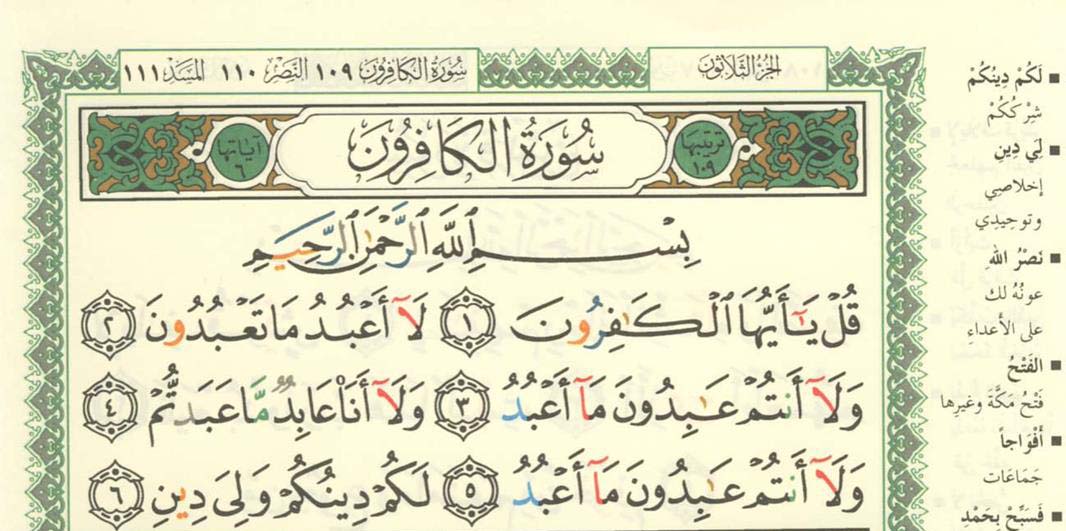
Translation
Here Allah addresses his beloved Prophet ﷺ to say the following to the disbelievers. Imam Razi explains that whenever the word Qul is used it is a renewal (and confirmation) of his* prophethood and messengership. The word Qul also highlights the importance of what is to come next and also emphasises a command to the Prophet ﷺ by Allah. What comes next are harsh words for the disbelievers Such harsh words were against the Prophet’s* nature of being kind, merciful and generous. Therefore, it was not appropriate for the Prophet ﷺto say this, so Qul made it clear that it was Allah who was ordering him to say it. Allah commands the Prophet ﷺ to call out the disbelievers and in this is a disparagement for the polytheists and disbelievers because they did not like to be called this.
Allah tells the Prophet ﷺ to tell the disbelievers that he does not worship the gods they worship, and they do not worship the god he worships. Namely, the disbelievers are highlighted as ignoramuses for not worshiping the true god who is transcendent and in no need of other intermediate false gods for him to be worshiped. That is the god whose attribute is of divine oneness whereas the understanding of the polytheists was not that and therefore were worshipping false gods.
These verses are repeated to emphasise to the disbelievers about rejecting the offer they proposed of “shared worship”. However, instead of La a’budu as mentioned in the first word, here we have the active participle aabid in wa la ana aabidum could be interpreted as “I am not a worshipper of your worship”. Namely, it is as the Prophet ﷺ is commanded to tell the polytheists that he doesn’t worship in they worship by setting up intermediate gods.
Another explanation is the apparent repetition is because the disbeliever’s proposal related to two periods of time, one in which everyone would worship Allah and one in which everyone would worship the idols. So, the two negating verses negate each proposal for each time period.
The first two verses relate to the future (or present) and the last two relate to the past, meaning ‘I will never worship what you worship in the future’ and the proof of this is that I have never worshipped your idols in the past, so how can I now, having proclaimed Islam, start to worship idols Similarly it is stating that you have never worshipped the true God I invite you to, so how will you do so now?!
This verse is like an addendum for emphasis that the disbelievers would never believe. The word deen has the meaning of belief (Aqida) to which one ties himself and live by and another meaning of deen is a nation or recompense. Allah is saying to the disbelievers that their disbelief is only confined to themselves and does not cross over to even impact the believers so how can it effect their guide, the Prophet ﷺ? When the Prophet ﷺ is ordered to say “wa liya deen”, it is as if he is saying “to me is my belief of oneness which my believing followers took allegiance upon, and it is confined to us whilst you are deprived of it”. This verse is a warning for the disbelievers that the recompense waits for them and is not about giving them permission to continue with their deen. A grammatical point to note in this verse is that the subject and predicate are inversed. Instead of saying “your religion is for you and my religion is for me” the verse is “for you is your religion and for me is my religion” making exclusivity for disbelievers and for the Messenger of Allah. It is as if the Prophet ﷺ is commanded to tell them that the religion which the disbelievers follow is exclusively for them and nothing to do with how he himself* and his followers are.
