



Durood Nariya
Durood Nariya (Urdu: درود ناریہ; “Fiery Salutation”), or Salat al-Nariya (Arabic: الصلاة النارية; “The Fiery Prayer”), also known as Salat al-Tafrijiyya (Arabic: صلاة التفريجية; “The Prayer of Relief”), is one of the most well-known prayers upon the Prophet ﷺ. It is traditionally attributed to Imam al-Qurtubi and is also known as Salat al-Taziya (Arabic: صلاة التازية) due to its association with Shaykh Abd al-Wahhab al-Tazi. This comprehensive prayer upon the Prophet ﷺ is renowned throughout the Muslim world as a means of seeking relief from hardships, the removal of distress, and protection from trials and tribulations.
Read lessArabic, Transliteration and Translation
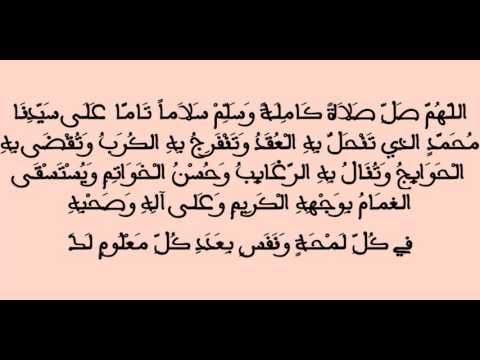
اللَّهُمَّ صَلِّ صَلَاةً كَامِلَةً ❁ وَسَلِّمْ سَلَامًا تَامًّا ❁ عَلَى سَيِّدِنَا مُحَمَّدٍ الَّذِي تَنْحَلُّ بِهِ الْعُقَدُ ❁ وَتَنْفَرِجُ بِهِ الْكُرَبُ ❁ وَتُقْضَى بِهِ الْحَوَائِجُ ❁ وَتُنَالُ بِهِ الرَّغَائِبُ وَحُسْنُ الْخَوَاتِمِ ❁ وَيُسْتَسْقَى الْغَمَامُ بِوَجْهِهِ الْكَرِيمِ ❁ وَعَلَى آلِهِ وَصَحْبِهِ ❁ فِي كُلِّ لَمْحَةٍ وَنَفَسٍ بِعَدَدِ كُلِّ مَعْلُومٍ لَكَ ❁
Allāhumma ṣalli ṣalātan kāmilatan, wa-sallim salāman tāmman, ʿalā sayyidinā Muḥammadini lladhī tanḥallu bihi l-ʿuqadu, wa-tanfariju bihi l-kurabu, wa-tuqḍā bihi l-ḥawā’iju, wa-tunālu bihi r-raghā’ibu wa-ḥusnu l-khawātimi, wa-yustasqā l-ghamāmu bi-wajhihi l-karīmi, wa-ʿalā ālihi wa-ṣaḥbihi, fī kulli lamḥatin wa-nafasin bi-ʿadadi kulli maʿlūmin lak.
O Allah, send a perfect prayer and complete peace upon our master Muhammad, through whom knots are untied, and distresses are relieved, and needs are fulfilled, and desires are attained, and good endings are granted, and through whose noble face rain is sought from the clouds, and upon his Family and Companions, with every glance and every breath, by the number of all that is known to You.
Video
About Durood Nariya
The virtues of Durood Nariya, also known as Salat al-Nariya (“The Fiery Prayer”) or Salat al-Tafrijiyya (“The Prayer of Relief”), have been mentioned by numerous scholars throughout Islamic history. One of the most detailed accounts appears in Khazinat al-Asrar (“Treasure Trove of Secrets”) by the nineteenth-century Turkish scholar and gnostic Shaykh Muhammad Haqqi Effendi al-Nazili (d. 1301 AH/1884 CE). In this work, Shaykh al-Nazili transmits reports from earlier scholars regarding the merits of this blessed prayer and the benefits associated with its regular recitation.
Imam al-Qurtubi
Shaykh al-Nazili quotes the renowned Andalusian scholar Imam al-Qurtubi (d. 671 AH/1273 CE), who said:
Whoever recites this prayer regularly each day, 141 times or more, Allah will relieve him of grief and sorrow, remove his worries and difficulties, make his affairs easy, illuminate his heart, elevate his rank, improve his condition, increase his provision, and open for him many doors of goodness. His words will carry influence, he will be protected from misfortunes and calamities such as famine and poverty, and love for him will be placed in the hearts of people. There is nothing he asks of Allah except that Allah grants it to him.
Imam al-Qurtubi further said:
These benefits are attained only through regular recitation. This prayer is among the treasures of Allah, and its recitation is a key to those treasures. Whoever remains constant in this invocation will be granted spiritual openings and, through them, will attain that which Allah has decreed for him.
Shaykh Muhammad al-Sanusi
Shaykh Muhammad al-Sanusi (d. 1276 AH/1859 CE), the Algerian founder of the Sanusi Tariqa, added the words fī kulli lamḥatin wa-nafasin bi-ʿadadi kulli maʿlūmin laka to the end of the invocation. He is reported to have said:
Whoever persists in reciting this invocation 11 times each day, it is as though it causes provision to descend from the heavens and spring forth from the earth.
Imam al-Dinawuri
Shaykh al-Nazili also relates the following statements from Imam al-Dinawuri regarding the merits of regular recitation:
11 recitations after each obligatory prayer
Whoever recites this salutation 11 times after every obligatory prayer and adopts it as part of his regular litany will never have his provision cut off, and will attain lofty ranks and abundant wealth.
41 recitations after Fajr
Whoever regularly recites it 41 times after the Dawn Prayer each day will have his needs fulfilled.
100 recitations daily
Whoever regularly recites it 100 times each day will attain what he seeks, and even more than he hoped for.
313 recitations daily
Whoever regularly recites it 313 times each day, corresponding to the number of the Messengers, upon them be peace, seeking the unveiling of spiritual realities, will behold all that he wishes to see.
1000 recitations daily
Whoever regularly recites it 1000 times each day will receive blessings beyond description: what no eye has seen, no ear has heard, and what has never occurred to the heart of man.
The 4444 Recitation
Elsewhere in Khazinat al-Asrar, Shaykh al-Nazili describes a traditional practice in North Africa for seeking relief from hardship or the fulfilment of an important need:
Among the prayers proven through experience is the Prayer of Relief (al-Salat al-Tafrijiyya) transmitted from al-Qurtubi. The people of the Maghreb call it the Fiery Prayer (al-Salat al-Nariyya), because whenever they seek the fulfilment of an important need or protection from an impending hardship, they gather together in a single assembly and recite this prayer 4444 times. By Allah’s permission, they quickly attain what they seek. Those versed in the spiritual sciences refer to it as Miftah al-Kanz al-Muhit li Nayl Murad al-‘Abid (“The Key to the Encompassing Treasure for Attaining the Servants’ Needs”).
Traditionally, when this method is followed, the total of 4444 recitations is divided among a group of regular reciters, often 7 or 11 people. For example, if there are 11 participants, each person recites the prayer 404 times. Once the recitation is completed, those present collectively supplicate to Allah, asking Him to fulfil the need for which the gathering was held.
Shaykh al-Nazili’s Ijaza
Shaykh Muhammad al-Nazili also records how he received authorisation (ijaza) to recite this prayer:
I received authorisation to recite this prayer in this wording from Shaykh Muhammad al-Sanusi atop Mount Qubays in Mecca. Thereafter, I received authorisation from Shaykh al-Maghribi, followed by Shaykh Sayyid Zayn ibn Makki, may Allah be pleased with them all.
Shaykh Abd al-Wahhab al-Tazi
Salat al-Nariya is also referred to as Salat al-Taziya due to its association with the great Moroccan scholar and gnostic Shaykh Abd al-Wahhab al-Tazi (d. 1206 AH/1792 CE) of Fez. He was a distinguished student of Shaykh Abd al-Aziz al-Dabbagh (d. 1132 AH/1719 CE) and later became one of the teachers of Shaykh Ahmad ibn Idris al-Fasi (d. 1253 AH/1837 CE), through whom the prayer became widely known.
Reported Virtues
According to Salawat literature, the regular recitation of Durood Nariya is associated with the following benefits:
- Relief from grief, sorrow, worries, and difficulties.
- Ease in one’s affairs and an increase in provision (rizq).
- Illumination of the heart and elevation in spiritual rank.
- Improvement in one’s condition and the opening of many doors of goodness.
- Protection from misfortunes, calamities, famine, and poverty.
- Love and acceptance being placed in the hearts of people.
- The fulfilment of lawful needs and supplications, by Allah’s permission.
- Spiritual openings (futuh) through regular recitation.
- Abundant provision through consistent daily recitation.
- The fulfilment of needs and the attainment of one’s goals.
- The unveiling of spiritual realities through increased recitation.
- Blessings beyond description through abundant recitation.
- Relief from hardship and the fulfilment of important needs through the traditional 4444 recitation.
Recommended Recitation
Scholars and spiritual masters have recommended the following recitations:
- For abundant provision, lofty spiritual rank, and wealth: Recite 11 times after each obligatory prayer.
- For the fulfilment of one’s needs: Recite 41 times after the Fajr prayer.
- For attaining one’s goals: Recite 100 times each day.
- For the unveiling of spiritual realities: Recite 313 times each day.
- For immense and indescribable blessings: Recite 1000 times each day.
- For relief from hardship and the fulfilment of an important need: Recite 4444 times collectively. Traditionally, this total is divided among a group of regular reciters (often seven or eleven people), after which those present collectively supplicate to Allah for the fulfilment of their need.
Names
| Name | Meaning |
|---|---|
| Salat al-Nariya | Translated as “The Fiery Prayer,” this name is derived from the Arabic word nar (fire) and reflects the traditional belief that regular recitation of this prayer brings about the fulfilment of one’s needs with great swiftness, just as fire spreads rapidly. |
| Salat al-Tafrijiyah | Translated as “The Prayer of Relief,” this name reflects the traditional belief that Allah grants relief from hardship and distress to those who recite it regularly. |
| Salat al-Qurtubiyya | This name is derived from Imam al-Qurtubi, the renowned Andalusian scholar to whom the prayer is traditionally attributed. |
| Salat al-Taziya | This name is derived from Shaykh Abd al-Wahhab al-Tazi, the Moroccan scholar and gnostic who is closely associated with the widespread transmission of this prayer. |
| Salat al-Kamila | Translated as “The Complete Prayer,” this name reflects the comprehensive nature of its blessings and supplications. |


-
-
-
-
-
-
-
-
-
-
-
-
-
-
-
-
-
-
-
-
-
-
-
-
-
Show Commentsاللھم صل علی محمد
جزاک اللّٰہ خیر کثیر
Great work and excellent explanations and translation.
Love you.
Sallallahu Alaihi Wassalam
Do i need permission (ijazah) to recite the salawat?
Merci infiniment pour tous ces détails.
Qu’Allah t’accorde beaucoup beaucoup de mérites pour ces bonnes actions !!!
Sallah LLAHU Alayhi Was Salaam ❤️❤️💜❤️💜❤️💜💜❤️💜❤️
Alhamdulillah, I am happy to see the meaning. I always found meaning but it was not fully clear. Today I am satisfied. I love this.
Thank you very much. God bless you.
can we please have the swahili translation.
Is there any reference from hadith regarding this durood?
Masha Allah this is one of my favorite prayers ever! Learned this from my sheikh when I was about 8
Q32:17 Now no person knows what delights of the eye are kept hidden(in reserve) for them as a reward for their(good) deeds. That is paradise.
What does it mean by Whosoever reads it regularly 1000 times daily will receive what cannot be described by those gifted at description — what no eye has ever seen, what no ear has ever heard, and what has never occurred to the heart of man. What is the thing that no one ever heard or seen?
Это про рай
Salaam please grant me permission to read this durrod
Is it wa Nafsin or wa nafas because in the youtube video they say wa nafas
This Darood is also called Salaatul Naariya. Why? It is said that we have to pray nafil namaz before we recite this Darood. Is it so?
I find there are many versions with slight differences. Can we recite them?
Thnks you so much
Shukran jxkllh khairan
Is there any authentic hadees for this salawat naariyath? Pls replay
how do i reciete this, if i need (1)fahami (2)luck in everthing quickly.
tant que tu cherche a plaire ALLAH ,ALLAH t aidera a lui plaire et lui aussi tu lui plairera in challah
je suis tres heureuse de decouvrir cette priere .
Please grant me permission to read this Durood.
So nice
Alhamdulilah Rabil Aaalamin Maa Sha Allah, Am releif
Very useful ☺️👍
hello Sir can i also receive permission to read this dua?